
Types of Pools
Know the types of pools that exist, as well as the advantages and disadvantages of each one. This is your first decision before starting the building your pool.
Types of Pools
Skimmer
Pools with a skimmer are pools made up of an ABS plastic nozzle that allows water to enter and circulate, as well as helping to maintain and clean the pool.
The Skimmer is an accessory that is placed on the opposite side of the impulsion nozzles (return nozzles) on the pool wall, just below the border stone and that must be positioned in order to receive the prevailing winds of the place and thus receive the current of water.
The existing dirt on the surface of the pool, such as insects, leaves, oils from suntan lotions and sunscreens, hair, fur, etc., is channeled to the skimmer and a part will be deposited in the cup/basket inside the skimmer. This cup also allows the placement of chemical products, such as water treatment tablets.
The skimmer piping is connected to the swimming pool circulation pump (as well as the bottom drain and the suction socket).
As a rule, currently the skimmer is no longer used as a suction outlet (although it can be), nor is it connected to a level regulator because this regulator is usually independent.
Skimmer-type pools are the most common, as they are easier to install and cost less, unlike overflow pools (infinity pools) or gutter pools.
The Skimmer is, therefore, an essential part of any pool in order to circulate the water and contribute to the hygiene of the pool.
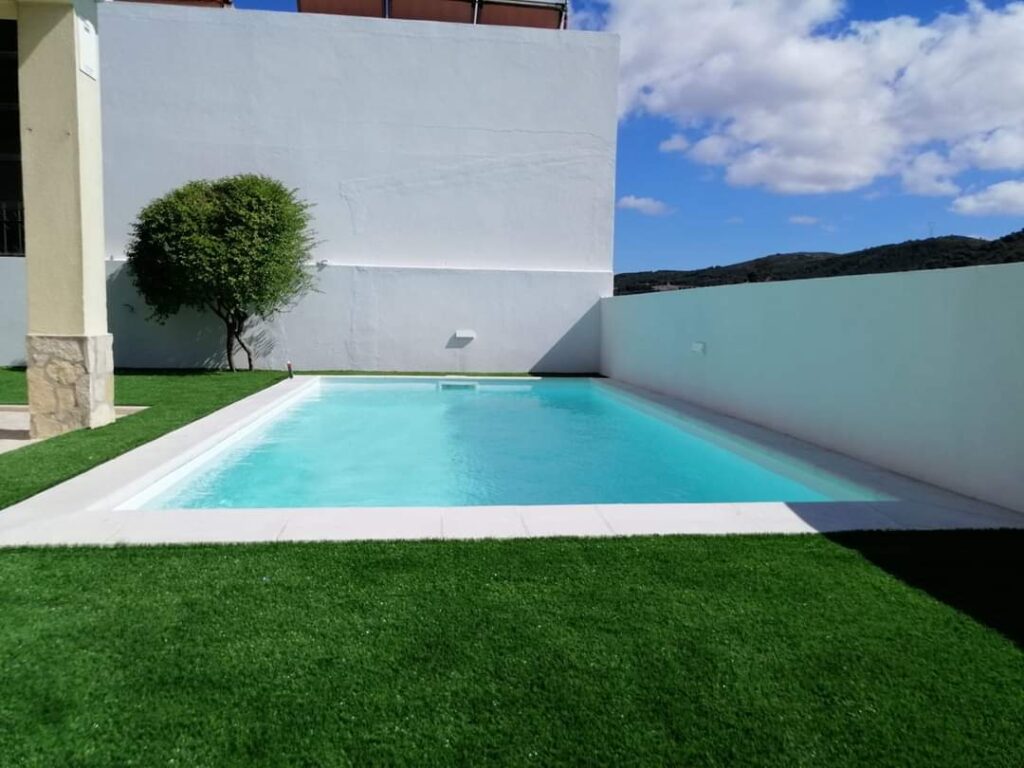

Transhipment
Infinity pools (Transbordo) are an increasingly popular option among those looking for a luxurious and elegant pool environment. These pools are designed to give the impression that the water extends to the horizon, creating a sense of continuity with the surrounding environment.
The main feature of an infinity pool is the free edge, which is created using a special construction technique called “submerged efflux”. This allows the water to flow smoothly over the edge of the pool, creating the illusion that the water extends beyond the edge of the pool.
In addition to being an aesthetically appealing option, infinity pools can also offer other advantages. For example, they can be designed to take full advantage of the view of the surrounding environment, be it a panoramic view of the city or the sea. In addition, they can also be designed to integrate with the surrounding landscaping design, creating a garden environment that merges with the pool.
Infinity pools can be designed with different additional features such as hydromassage jets, waterfalls and underwater lighting to further enhance the diving experience.
However, it is important to remember that infinity pools are more expensive than traditional pools due to the complexity of construction and the high quality materials required. In addition, these pools also require regular maintenance, from cleaning the filters and maintaining the pumps, to ensure that the water continues to flow smoothly over the edge of the pool.
Infinity pools are a luxurious and stylish option for those looking for a modern and sophisticated pool environment. With their free edge and design integrated with the surrounding environment, they are pools that offer a unique and stunning diving experience. However, it is important to consider costs and the need for additional maintenance before deciding to build an infinity pool.
It is recommended to consult a pool construction and design professional to ensure that the pool meets your needs and fits your budget. With proper planning and expert construction, an infinity pool can be a valuable and stunning addition to any property.
Water mirror
A water mirror pool is essentially an overflow pool that creates a water mirror effect and provides a more natural and integrated appearance to the space around the pool, in addition to allowing greater cleanliness of the water, and due to issues hygiene is the mandatory system in public swimming pools.
The entire perimeter of the pool is surrounded by an overflow channel, unlike overflow pools (infinity edge) which can only overflow on 3, 2, or 1 sides to the gutter, or a wall or two.
The waterline is flush with the edge of the pool and overflows into this channel. The channel is usually covered with a plastic grid. However, in high quality domestic pools, it is increasingly common to cover the drain channel with tiles or edging stones for a more luxurious finish.
This channel leads to a surge tank.
The surge tank is an additional holding tank that is located underground, below the level of the pool. Water from the overflow channel is drained into the surge tank. This water is then directed through the filtration system, before being pumped back into the pool.
The surge tank is usually constructed of concrete or plastic and capable of holding between 10% and 15% of the total pool water volume.
Therefore, pools using an overflow system or at deck level require more space. It is something to consider at the design stage. Once construction begins, it is very difficult to change the pool design to incorporate an overflow design. This pool rail is a form of pool finish that helps to give a more natural and integrated look to the surrounding space, as well as protects the edge of the pool and provides a non-slip surface. It can also be used to create a smooth transition between the pool area and the surrounding space and to hide elements such as pumps and filters.


Durability
Durability varies depending on the type of pool, the coating used and the maintenance carried out.

Guarantee
All our work and equipment sold are guaranteed.

100% Watertight
The pools built are 100% watertight for greater profitability.

Accessories
We have all kinds of accessories and products for the maintenance of your pool. Contact us!
Shall we build your pool?
We build your new Pool in Cement Blocks or Polystyrene Blocks and we also have Wooden Pools available.